
10.20.2025 Ebby Bowles
For the better part of the past decade, it seemed like the short-term rental (STR) business was here to stay. Millions of property owners were able to monetize their investment through Airbnb with minor involvement, creating an opportunity to rake in passive income. However, a global pandemic that ground travel plans to a halt–followed by a spike in occupancy that flooded the market with subpar STR options–started to show some cracks in the business model.
As of 2026, many U.S. markets are facing challenges, including lower demand and stricter regulations, that point to a potential “collapse.” Others, meanwhile, are showing promise for stable, if subdued, growth.
For investors, location will be just as, if not more important than, the property itself when it comes to turning a profit and seeing a return on investment. To help you pinpoint the locations to look into (and the areas to avoid), we analyzed data provided by AirDNA to find the top hidden markets expected to experience either an Airbnb collapse or boom based on findings for 2025 and the outlook report for 2026. Let’s take a closer look.
What Is the “Airbnb Collapse?”
Following the post-pandemic travel frenzy that refreshed the STR market, many investors decided it was a better option to use their properties as Airbnbs instead of selling them. The ripple effect of too many available options on the market caused an imbalance in supply and demand, with prices dropping too low because of increased competition.
Likewise, with the U.S. economy facing higher inflation rates, Airbnb property upkeep costs became too high for some owners who weren’t breaking even. And as the travel boom slowed down, it didn’t make much sense to keep the Airbnb properties running amid dwindling demand.
Paired with Airbnb’s crackdown on fraudulent listings, which removed over 59,000 properties, as well as stricter legislation in busy markets, customers found their options to be more limited. The result? Traditional hotels have once again become an attractive option.
Although some would call this phenomenon “collapse,” it may be more accurate to think of it as market maturity. Many of the Airbnb owners whose properties didn’t weather the storm weren’t experienced in the hospitality industry. Moreover, state regulations that limit who can and cannot use their property as an Airbnb aim to prevent potentially dangerous situations for both hosts and guests.
That said, there’s still a large gap between the markets that maintained high occupancy rates and a good ROI in recent years and others that weren’t so lucky.
Top 5 Markets Affected by the Airbnb Collapse
Even though the dropping number of listings could be chalked up to demand and supply evening out, it’s still a gamble buying into any of the following markets:
1. Orlando, FL
Orlando is home to most of the United States’ major theme parks and other multi-day attractions, which makes it, in theory, an excellent market for STRs. At least, this was the case until too many investors bought into the market, using risky loans, creating higher expectations for guests, and eventually driving the prices way down when no one showed up.
The result was an entire Orlando suburb, Kissimmee, sitting vacant, even during the region’s busiest travel season.
2. Annapolis, MD
Maryland was once viewed as a haven for investors fleeing the high prices of New York and New Jersey, but local legislation is limiting opportunities. In both Annapolis and Baltimore, you can find regulations on how many STRs can exist per block, and all STRs need to be registered as the owner’s primary residence.
3. Maui, HI
While occupancy rates in Hawaii will probably always be high, local regulations are currently stricter than ever. This comes as a backlash for how saturated the market has become in recent years because of development restrictions. The high cost of living in Maui, among other Hawaiian islands, can also cut into profits.
4. Santa Monica, CA
High-occupancy tourist areas in California, like Santa Monica, have begun their transition away from STRs, with hostile legislation to Airbnb owners already in place. Any short-term “home-sharing” under 30 days requires the owner to be present and the property to be registered as a primary residence. That’s not to mention the 14% Transient Occupancy Tax (TOT) and strict occupancy limitations.
5. New York City, NY
In an effort to almost ban STRs in New York City, Local Law 18 states that the host must register with the Office of Special Enforcement (OSE), all rentals under 30 days have to have the host present, and no locks are to be placed on internal doors to guest rooms.
You might notice this doesn’t reduce occupancy rates in NYC, but it effectively filters out many would-be investors from the market who can’t meet these demands. And even if the potential for earnings tempts investors to jump through these hoops, future regulations might negatively impact that very potential.
4 Hidden Markets Where Airbnb is Booming
It’s not all doom and gloom for the Airbnb market in the U.S. Some markets are becoming a hotbed for investors looking for a good ROI thanks to falling property prices, more lax STR regulations, and a relative stability in demand.
1. Buffalo, NY
Unlike “The City” that boasts some of the nation’s highest property prices, Buffalo is more investor-friendly. No local laws exist for STRs besides the need for the proper license and following zoning laws. You should also disclose any recording devices on the property, but that’s about it.
2. Sarasota, FL
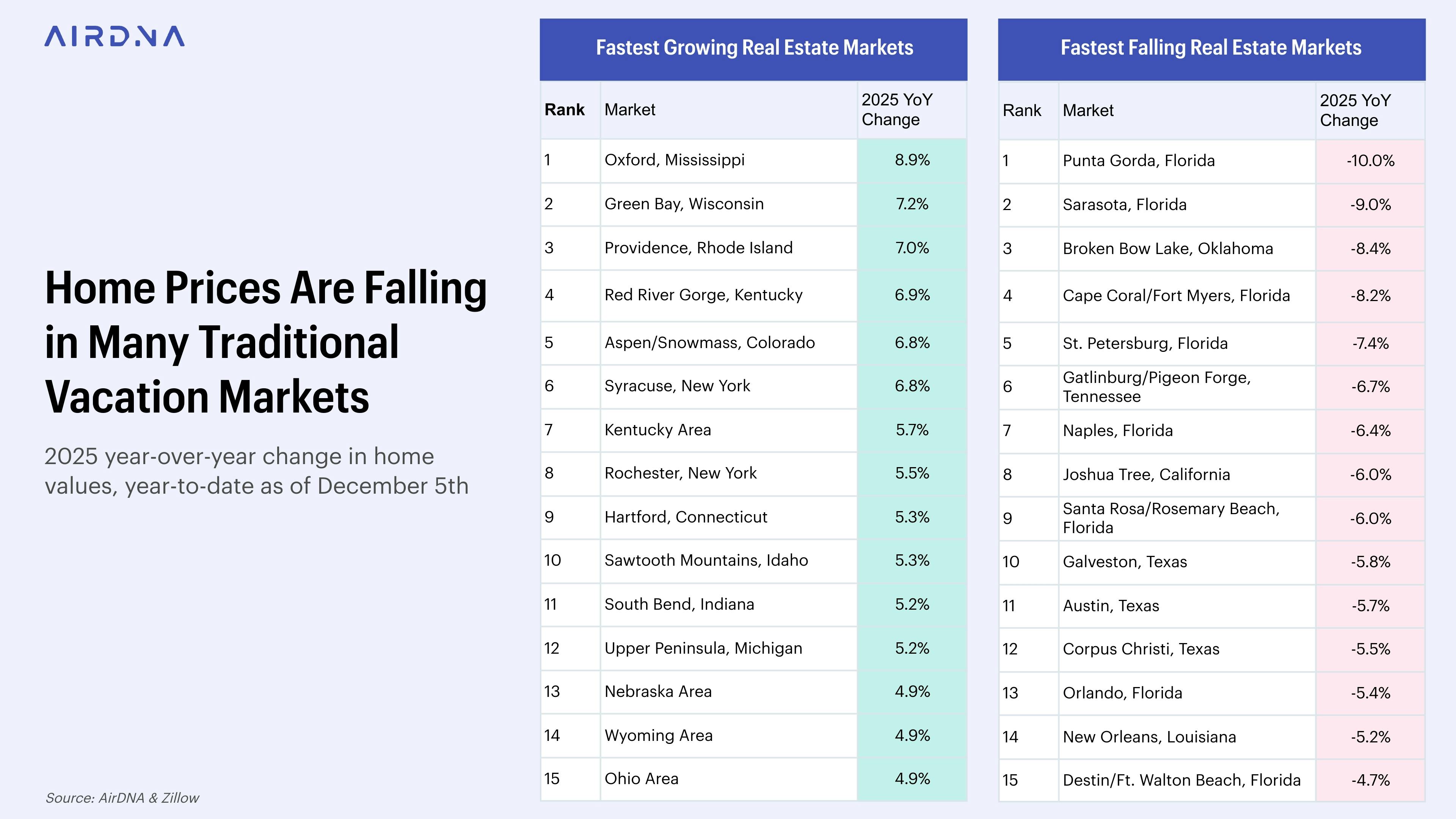
If you want to take advantage of Florida’s zero income tax, maybe investing in a Sarasota property is the right move. It has one of the fastest-falling real estate markets in the U.S., scoring -9% in YoY change according to AirDNA. It’s also a beautiful, quiet beach destination that has a lot of potential as a Florida vacation hub.
3. Austin, TX
Once a tech investor’s haven with skyrocketing property prices, Austin’s real estate market is settling down. Dubbed a buyer’s market byRealtor.com, it’s also another no-income-tax city with a lively food, music, and cultural scene.
4. New Orleans, LA
As the home for Mardi Gras celebrations and music festivals that attract visitors from across the country, New Orleans has a lot of potential for STR investments. Although the strict regulations might put off some investors, the downtrending real estate market in New Orleans could even out the risk.
Will Airbnb’s Decline Affect the Short-Term Rental Market?
The STR business model has a lot of positives to offer both hosts and guests. If Airbnb isn’t providing the right kind of support for its users to face issues like local regulations and market fluctuations, another service provider may take over in its stead.
It’s also true that Airbnb itself has pivoted its business strategy to account for many of the changes that have impacted the platform. Airbnb-friendly apartment buildings, for example, allow investors to benefit from both short- and long-term rentals under one roof while still complying with local regulations.
If you’re interested in owning an STR property, it pays (literally) to do your homework first. Before you begin scoping the market for good deals, make sure the market itself is where you want to be.
A property search tool can help you find the right investment opportunity by allowing you to pinpoint areas experiencing growth. It’s also wise to consider the area’s eligibility beyond legislation or regulations – in other words, is it an ideal location for the type of short-term rental you’d like to invest in? Explore other relevant metrics like property taxes, home prices, tourism traffic, and more to paint a complete picture of the area you’re interested in.
Key Takeaways: Are Short-Term Rental Investments Worth It?
As shown in the examples above, the experience of investing in an STR property can widely vary, even among different cities in the same state!
Doing the necessary research before you decide to purchase a property is crucial so you can avoid buying a problematic property or investing in the wrong market. Don’t be afraid to broaden your horizons beyond Airbnb, too; the demand for short-term rentals isn’t inherently tied to a single platform. What matters most is that you position your STR in front of the people who are looking for it – at the right time, and at the right place.
Share


